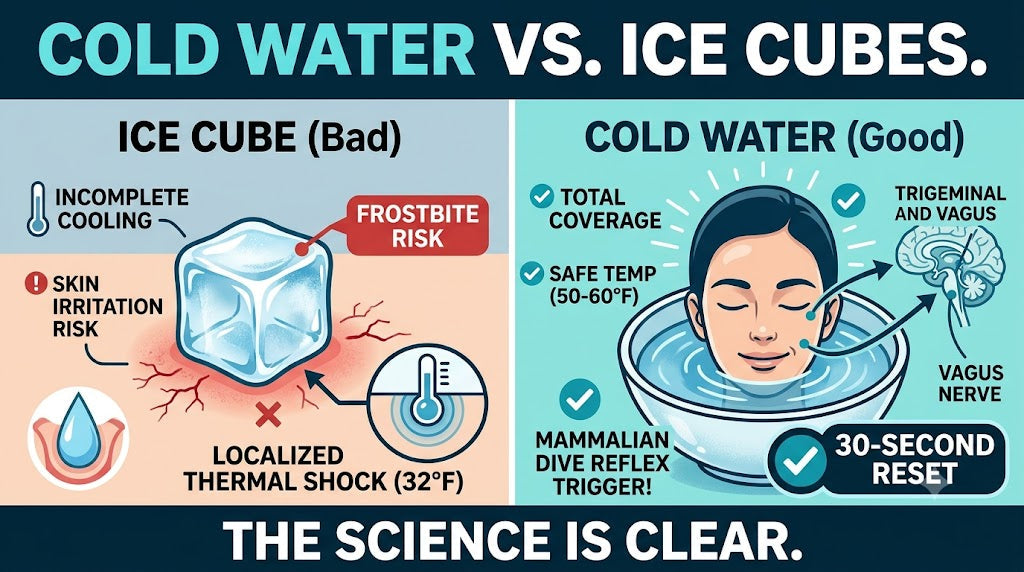
Ice cubes feel intense, but they only cool tiny patches of skin — and they can actually irritate it. Dunking your whole face in cold water is different. It cools your skin evenly, calms your nervous system, and leaves you looking less puffy and more awake in about 30 seconds. Same cold. Way better results.
Same idea. Wildly different results. The "glow" everyone's chasing isn't magic — it's a rapid physiological response. But how you deliver the cold completely changes what your body does with it.
What the cold is actually doing
Three real mechanisms are firing the moment cold water hits your face:
1. The lymphatic pump (vasoconstriction)
Cold causes your blood vessels to rapidly constrict, acting like a biological pump that squeezes out stagnant lymphatic fluid and cellular waste — the stuff that causes morning puffiness. When your face warms back up, vasodilation rushes fresh oxygen-rich blood to the surface. That vascular flush is the true source of the "glow."
2. Barrier-safe inflammation reduction
Puffiness is mild inflammation. To calm it safely, you need tissue temperature in the therapeutic range of roughly 50–60°F. Direct ice sits at 32°F and creates thermal shock that can damage the delicate lipid barrier and cause micro-trauma. Cold water delivers the thermal stress without the collateral damage.
3. The mammalian dive reflex
This is the critical difference. When you hold your breath and submerge your face, receptors in your trigeminal nerve (around your nose and eyes) signal the vagus nerve to activate the parasympathetic nervous system. Heart rate slows, cortisol drops, and your body physically shifts from "fight or flight" to "rest and digest" — a response you simply cannot trigger by dragging an ice cube across your cheek. (Cleveland Clinic on vagus nerve activation.)
Ice vs water — the head-to-head
The coverage problem
Ice cube: you're dragging ~1 square inch of freezing temperature across your face, leaving 95% of your skin untreated at any given second.
Cold water bowl: total, instantaneous coverage — jawline, cheeks, and under-eyes all receive the same therapeutic temperature simultaneously.
The ice-burn problem
Here's the thing nobody talks about: dragging a bare ice cube on skin can actually cause a mild ice burn — a low-grade form of frostbite. It's the exact reason doctors tell you to wrap ice in a towel when you're icing a sprained ankle. Direct ice on bare skin is too cold, too concentrated, and it damages the tissue you're trying to help.
Your face is even more vulnerable than your ankle. The skin under your eyes is roughly 4x thinner than the skin on your cheeks, and there's no towel between you and a 32°F cube. That's how you get broken capillaries, red blotches, and irritation the next day.
Cold water bowl: you can dial in the optimal 50–60°F window. All of the anti-inflammatory benefit, none of the burn risk.
The vagus nerve trigger
Ice cube: does nothing for your nervous system. Skin-level only.
Cold water bowl: full-face submersion is the biological key that unlocks the dive reflex. Without breath-holding and trigeminal contact, there is no vagal tone reset.
The time investment
Ice cube: 5–10 minutes of messy melting, dripping, and dragging.
Cold water bowl: 30 seconds. Done.
Brief, even cold = good. Prolonged or localized extreme cold = bad. A bowl of cold water for 10–15 seconds is the safest, most biologically effective version of this entire trend.
The 30-second protocol
- ✓Prep. Fill your Face Plunge bowl with cold water and a small handful of ice. Let it sit 60 seconds to settle into the 50–60°F window.
- ✓Breathe. One slow inhale. A longer exhale out.
- ✓Submerge. Hold your breath and put your whole face in for 10–15 seconds. Make sure water covers your eyes and nose — that's where the trigeminal nerve lives.
- ✓Repeat. Lift, breathe normally, and do one more round.
- ✓Finish. Pat dry and apply serum + moisturizer immediately, while circulation is peaked.
Get the full plunge protocol
We'll send the printable card: temperatures, breathing pattern, and the exact 30-second sequence.
No spam. Unsubscribe anytime.Ice cubes: spotty coverage, risks broken capillaries, zero nervous-system benefit.
Cold water plunge: even thermal distribution, safe on the barrier, actively lowers stress via the vagus nerve.
Same idea. Wildly better results.
Built for the 30-second plunge
The Arauris bowl is the right shape, depth, and weight to make this a daily habit.
Shop Face Plunge
Share:
The Dark Side of Rubbing Ice on Your Face
Puffy Eyes? Here's What's Actually Happening (And the 30-Second Fix)