THE FACE PLUNGE JOURNAL / CUSTOMER STORY + SCIENCE
A bedtime ritual.
An unexpected change.
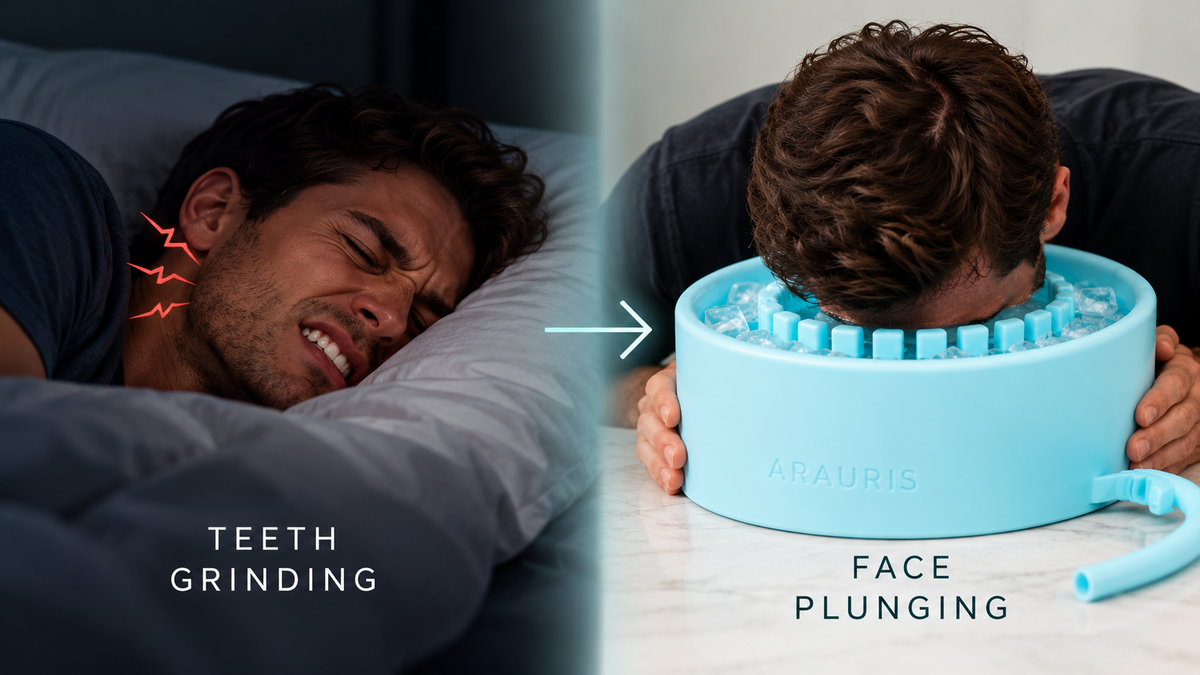
One customer's severe nighttime teeth grinding was affecting his sleep and his marriage. Then he added Face Plunge to his nightly routine.
Explore his story ↓The short answer
Cold water applied to the face can trigger measurable changes in autonomic nervous system activity. Stress and brief sleep arousals are also relevant to nighttime teeth grinding, known as sleep bruxism.
This raises an interesting question: could facial cold plunging influence the processes associated with nighttime teeth grinding? The connection has not yet been clinically established.
01 / THE CUSTOMER STORY
When teeth grinding disrupts more than sleep
For one Face Plunge customer, nighttime teeth grinding had become a serious problem. According to the account shared with our team, his grinding was so disruptive that his wife no longer wanted to sleep in the same bed.
Then he started Face Plunging (submerging just his face into cold water) before bed each night.
What happened next wasn't something he—or our team here at Face Plunge Company—expected. He called us to share that he had stopped grinding his teeth at night.
BEFORE / REPORTED
Disrupted nights
Severe teeth grinding, disturbed sleep, and disruption to sharing a bed with his wife.
AFTER / REPORTED
Stopped Grinding Teeth at Night
After beginning nightly Face Plunge use, he reported that his grinding stopped.
Customer-reported experience. No clinical measurements, independent verification, or controlled comparison are available. Individual experiences do not establish product effectiveness.

02 / THE PHYSIOLOGY
What happens when cold water touches your face?
Facial cold-water immersion can trigger the mammalian diving response, a natural reflex involving facial sensory pathways and the autonomic nervous system.
In human experiments, particularly when facial immersion is combined with breath-holding, researchers have observed slower heart rates and changes in blood pressure. The response involves both sympathetic and parasympathetic activity.
In a 1990 human physiology study, researchers observed marked heart-rate slowing during cold facial immersion with breath-holding. That finding demonstrates a measurable physiological response, but it does not establish a benefit for sleep or teeth grinding.
Read the facial cold-water immersion study (Paulev et al., 1990)
The facial cold-exposure response
STEP 01
Cold facial stimulationTemperature-sensitive facial pathways respond to cooling.
STEP 02
Autonomic reflexThe diving response involves cardiovascular control pathways.
OPEN QUESTION
Sleep-related effects?Whether bedtime facial cooling affects sleep bruxism is unknown.
Conceptual illustration, not a demonstrated pathway from facial cooling to reduced teeth grinding.
What is sleep bruxism?
Bruxism refers to grinding, clenching, or related activity involving the teeth and jaw muscles. It can occur while awake or during sleep.
The National Institute of Dental and Craniofacial Research identifies factors associated with bruxism that include stress, mood, genetics, certain medications, caffeine, alcohol, and smoking.
Sleep researchers have also observed that episodes of rhythmic jaw-muscle activity may follow brief changes in brain activity and heart rate during sleep, sometimes called micro-arousals.
This makes sleep bruxism more complex than simply having a tense jaw before bedtime.
NIH: Understanding Bruxism | Kato et al.: Sleep Bruxism and Micro-Arousals
03 / THE EVIDENCE
What science supports—and what it doesn't
ESTABLISHED PHYSIOLOGY
Facial cold stimulation affects autonomic responses.
Human experiments document heart-rate and circulatory responses to facial cooling, especially during breath-holding.
ESTABLISHED ASSOCIATIONS
Stress and sleep arousals can be relevant to bruxism.
Bruxism has multiple contributing factors. Some nighttime jaw-muscle episodes are associated with brief sleep arousals.
NOT CLINICALLY ESTABLISHED
Face plunging as a treatment for nighttime grinding.
Clinical research has not established that facial plunging prevents or treats sleep bruxism. A customer experience cannot establish causation.
What about cold water and sleep?
Researchers have investigated whether cold-water exposure affects stress, mood, and sleep quality. A 2025 systematic review reported some potentially favorable outcomes, while emphasizing limitations in the available studies.
A 2026 systematic review of cold-water exposure and psychological outcomes found inconsistent evidence and substantial risk of bias across the included research.
Importantly, these studies largely concern whole-body immersion, cold showers, or winter swimming—not Face Plunge or the treatment of teeth grinding.
2025 cold-water immersion systematic review | 2026 cold-water exposure systematic review
THE BIG QUESTION
Could facial cold exposure influence the processes associated with nighttime grinding?
It's worth investigating. The physiological research provides a reason to ask the question.
04 / FREQUENTLY ASKED QUESTIONS
Questions about face plunging and teeth grinding
Can a face plunge stop teeth grinding?
One Face Plunge customer reported that his grinding stopped after adopting a nightly routine, but there is no established clinical evidence that facial cold-water immersion stops sleep bruxism yet. More research is needed.
Does cold water on the face affect the nervous system?
Yes. Facial cold stimulation can trigger the diving response, which involves measurable autonomic and cardiovascular changes. That does not necessarily mean a person becomes more relaxed or sleeps better.
DISCOVER THE RITUAL
Meet Face Plunge Pure
A purpose-designed facial cold-water immersion bowl with a separate ice chamber that keeps loose ice away from your face.
Not intended to diagnose, treat, cure, or prevent bruxism.
Safety and editorial transparency
Cold facial immersion can affect heart rate and blood pressure. People with heart conditions, abnormal heart rhythms, fainting history, or other relevant health concerns should consult a healthcare professional before attempting facial cold immersion. Do not force or prolong breath-holding, and stop if you feel unwell.
This article is published by Face Plunge Company, a seller of facial cold-water immersion products. The customer experience is a self-reported account, not a clinical study. Scientific sources discussed above investigate different aspects of cold exposure, bruxism, and sleep; none establishes that Face Plunge treats nighttime teeth grinding.
Share:
Puffy Eyes? Here's What's Actually Happening (And the 30-Second Fix)